All about the historic Huntington Beach Pier!
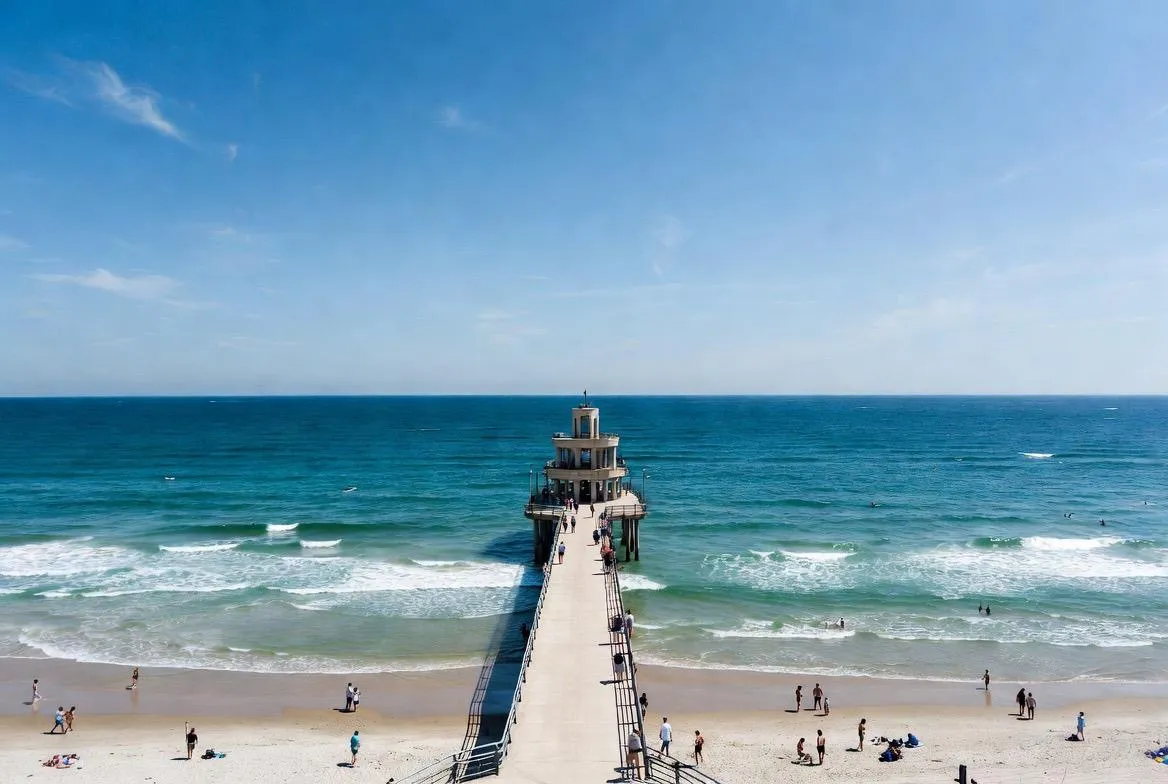
The Huntington Beach Pier is one of the most iconic landmarks on the California coast — a symbol of Surf City USA, resilience, community spirit, and the evolution of Southern California beach culture. At approximately 1,856 feet (about 566 m) long, it ranks among the longest public piers on the West Coast. It has been destroyed or severely damaged multiple times by storms, rebuilt each time, and stands today as both a functional public space (fishing, strolling, surfing spectatorship) and a National Register of Historic Places listing.
Here is a complete historical account drawn from primary records, architectural surveys (including HABS/HAER documentation), contemporary reports, and city/Wikipedia-sourced timelines.
Origins: How the Pier Came to Be (1902–1914)
Huntington Beach began as Pacific City in the late 19th/early 20th century. It was renamed around 1903–1904 after Henry E. Huntington, whose Pacific Electric Railroad reached the area in 1904, spurring development. The Huntington Beach Company (successor to the West Coast Land and Water Company) envisioned the town as a West Coast resort destination modeled on Atlantic City — a place to sell real estate and attract tourists.
To anchor this vision, the company built the first wooden pier in 1904 at the foot of Main Street. It extended roughly 1,000 feet (300 m) into the Pacific. Early wooden piers in the area (including experimental ones) were vulnerable; storms damaged or destroyed predecessors around 1906 and 1912 (sources vary slightly on exact early storm dates; Wikipedia notes major damage in 1910).
By 1911, the Huntington Beach Township trustees approved a $70,000 bond for a permanent replacement: a much longer, higher concrete pleasure pier.
Construction of the new pier began April 15, 1913, designed by Ernest Rothenburg and built by the Mercereau Bridge and Construction Company of Los Angeles. It was completed May 1, 1914. The structure featured reinforced concrete piles (203 total, jetted into place), cross girders, beams, and a deck with ornamental concrete light standards. It included distinctive “Tees” (platforms) and a Refuge Bay. At the time, it was celebrated as the longest and highest concrete pleasure pier in the United States.
The dedication in June 1914 was a massive two-day celebration attended by thousands (some accounts say up to 20,000). It was promoted as the “Pride of the Pacific” and later showcased at the 1915 Panama-Pacific International Exposition in San Francisco. Legendary surfer George Freeth gave a surfing demonstration at the event, tying the pier early to the sport that would define Huntington Beach.
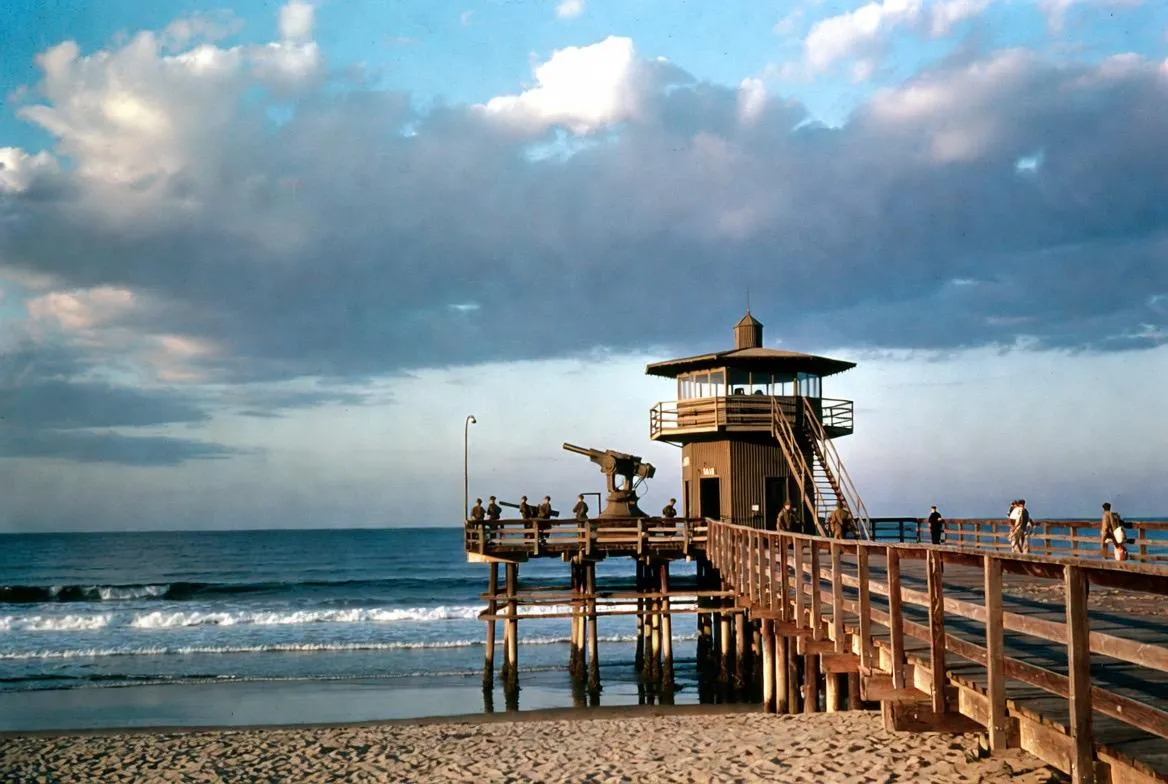
Authentic early 20th-century view of the Huntington Beach shoreline and pier area (circa 1900s–1910s wooden pier era), showing beachgoers and the long structure extending into the ocean.
Growth, Extensions, Earthquakes & Storms (1920s–1940s)
The pier quickly became central to the town’s identity as a resort and, later, as oil was discovered in the 1920s, an economic hub. Surfing gained traction; Duke Kahanamoku surfed and demonstrated at the pier in 1925, helping popularize the sport in California.
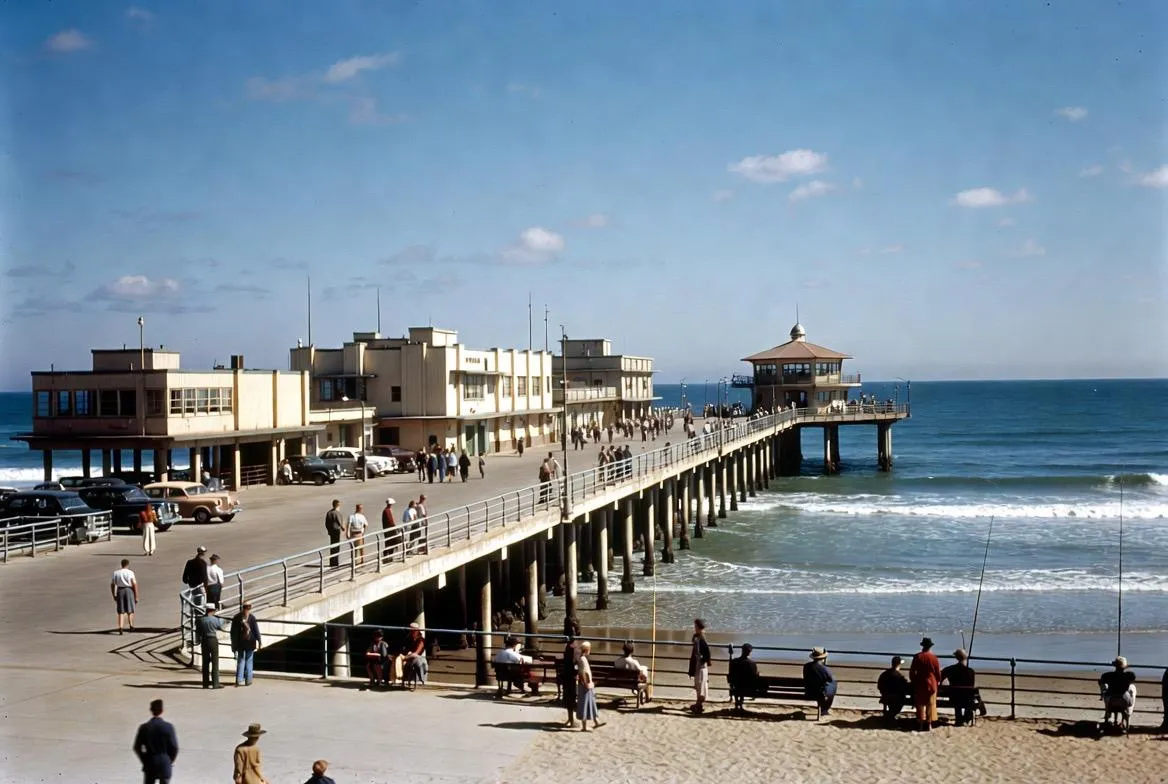
1930–1931 brought major work: piles were repaired (encased in gunite concrete shells) due to deterioration, and the pier was extended by about 500 feet (150 m) to a total of roughly 1,821 feet. Art Deco-style recreational buildings were added, including an octagonal “Sun Parlor” at the end and other concession structures designed by Schilling & Schilling. This project provided jobs during the Great Depression.
The 1933 Long Beach earthquake caused the 1931 extension to separate from the original pier; repairs followed. Then, on September 24, 1939, a severe California tropical storm destroyed about 295 feet of the extension and the Sun Parlor.
1940 reconstruction replaced the damaged end with a timber structure (~300 ft) and added what became known as the “End Cafe” on a new fifth Tee.
World War II transformed the pier again. After the attack on Pearl Harbor (December 7, 1941), the U.S. Army installed a submarine lookout post, searchlights, and a heavy-caliber machine gun for Harbor Defenses of Los Angeles. It served in this military capacity until mid-1945, after which it returned to purely public use. 
Post-War Era, Further Storms & Growing Fame (1950s–1980s)
Various repairs and upgrades continued: new lighting (1968), deck renovations (1970), railing and other work (1970s–1980s). The pier hosted growing crowds of surfers, fishermen, and beachgoers as Huntington Beach embraced its “Surf City” identity (the Beach Boys even referenced shooting the pier in song).
Storms remained a recurring threat. Significant damage occurred in 1983. In 1985, a controversial modern two-story restaurant was built at the pierhead.
The most devastating event came on January 7, 1988, when powerful Pacific storms destroyed the outer section beyond the fourth Tee, including the 1985 restaurant and End Cafe. The pier was declared unsafe and closed in July 1988.
Destruction, Community Spirit & Rebirth (1988–1992)
The 1988 closure sparked an outpouring of local support. A grassroots group called P.I.E.R. (Persons Interested in Expediting Reconstruction) raised over $100,000 through T-shirt and merchandise sales. Huntington Beach’s sister city, Anjo, Japan, donated approximately $92,000. This community effort, combined with other funding, made reconstruction possible.
The pier was added to the U.S. National Register of Historic Places on August 24, 1989 (and the California Register), recognized for its role in establishing Huntington Beach as a resort community and as a rare surviving example of early 20th-century reinforced concrete marine engineering.
New construction began in October 1990. The current 1,856-foot pier was engineered by Moffatt & Nichol to modern standards — reinforced steel with epoxy coating to resist corrosion, designed to withstand 31-foot waves or a 7.0-magnitude earthquake — while architecturally replicating the 1914 aesthetic (haunches at pile caps, corbels for lights, alternating octagonal platforms, and a rotated square/diamond-shaped platform at the seaward end). Pile spacing was increased to better accommodate surfers.
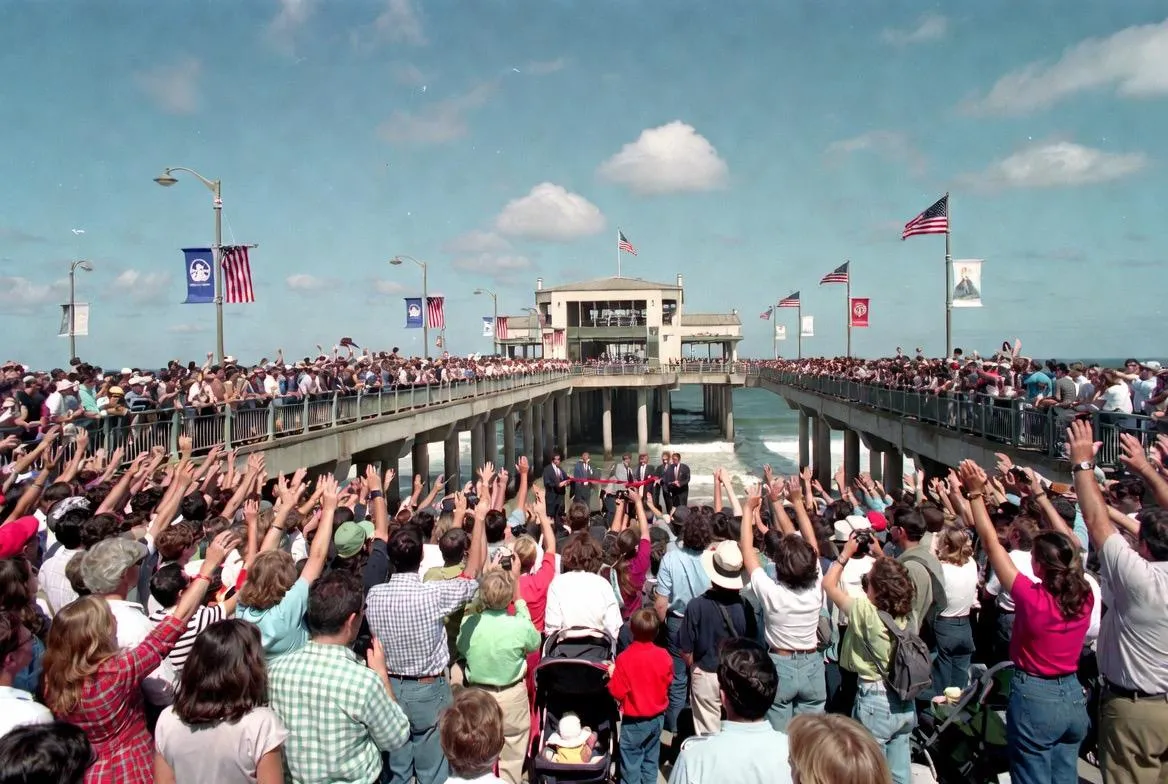
The grand re-dedication took place on July 18, 1992, with a massive public celebration attended by over 500,000 people — one of the largest gatherings in the city’s history. 
Modern Era & Enduring Legacy (1992–Present)
Ruby’s Diner opened at the end of the pier in 1996 and operated until early 2021. Subsequent tenants have included pop-up seafood spots and, more recently, Broad Street Oyster Company.
The pier remains under active city management with a dedicated observation and maintenance program. It is a 24/7 public space (with a midnight curfew enforced) featuring a live webcam. Rules prohibit bikes, skateboards, smoking, alcohol, and drugs on the pier. It is a prime spot for fishing, romantic walks, and watching world-class surfing — the pier’s location benefits from wave refraction around Catalina Island, creating consistent breaks.
It hosts or is central to major events including the U.S. Open of Surfing (one of the world’s largest), the Surf City Marathon, pier swims, Fourth of July celebrations, and more. The surrounding area includes the Surfing Walk of Fame and Surfers’ Hall of Fame.
Early 1900s – The original wooden pier era (circa 1904–1910), showing the simple but ambitious structure that started it all.
1914 – The grand concrete pier dedication, “Pride of the Pacific,” with crowds and early surfing ties.
1930s – The extended pier with Art Deco recreational buildings, a lively Depression-era scene that also provided jobs.
World War II era – The pier’s brief but important role in coastal defense after Pearl Harbor.
July 18, 1992 – The triumphant reopening after the 1988 destruction, a massive community celebration.
Today – The pier as it stands now, still the beating heart of Huntington Beach’s beach culture.
The pier’s story is one of ambition, repeated destruction by nature, and unbreakable community resolve. From a 1904 wooden gamble to promote a new resort town, through wars, earthquakes, and devastating storms, to a 1992 rebirth that drew half a million people — it embodies Huntington Beach’s spirit.
Borrowing is viewed as a loss of freedom.
LEARN ABOUT OTHER FAMOUS PLACES: Old Town San Diego, Old Towne Orange, Old Town San Clemente, Old Town Monrovia, Old Town Tamecula, Old Town Pasadena, Old Town Sacramento, Old Town Bern, Old Town Stockholm, Old Town Prague, Old Town Lijiang, Old Town Alexandria, Old Town Albuquerque, Old Town Cottonwood, Old Town Quedlinburg, Old Town Rothenburg ob der Tauber, Old Town Marienplatz Munich, Flipside Point, Alexanderplatz Old Town Berlin, Old Town Chicago, Old Town Kissimmee Florida, Phuket Old Town, Old Town Asakusa, Old Town Madrid Major Square, Kraków Old Town, Old Town London Piccadilly Circus,
~ ADVENTURER QUOTE:
“Courage is being scared to death and saddling up anyway!” – John Wayne
Visit Us At:
FLIPSIDE POINT
~ “I don’t know, I’m making this up as I go.” — Indiana Jones ~
19171 Magnolia, Huntington Beach, CA 92646
"Thanks For Being Incredible!"
Great ARTICLES: How The Great Pyramid in Egypt Worked, History of RIIP Brewery, All About GREEK Mediterannean Food, World Cup Information, Best Restaurants of Huntington Beach, History of Huntington Beach Pier, Huntington Dog Beach, Old World Huntington Beach, History of Detroit vs. New York Pizza, History of Riip Pizza, History of the New York Pizza, History of the Detroit Deep Dish,
This website is owned and operated by (c) 2026 - University of San Clemente Inc.