
All about the Detroit Deep Dish Pizza!
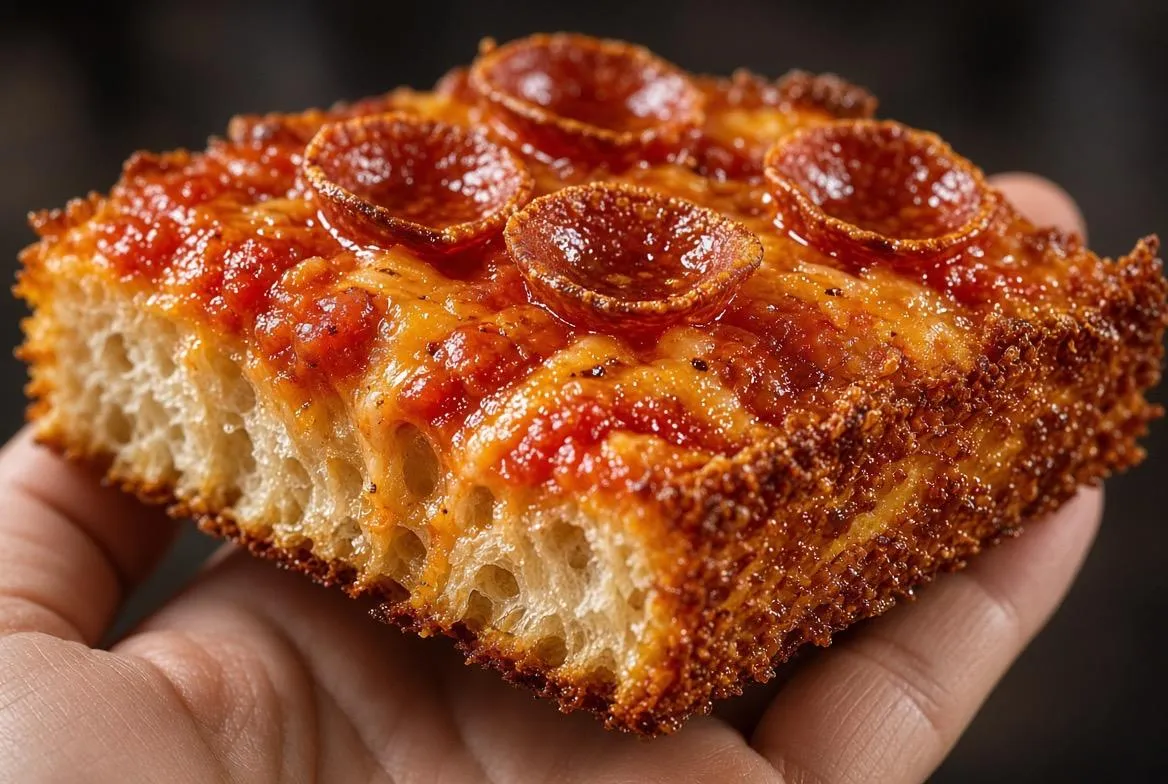
Detroit square pizza is a Motor City invention with Sicilian dough, Wisconsin cheese, and an auto-factory pan. It stayed local for decades. The name “Detroit-style” is newer than the pie.
What it is
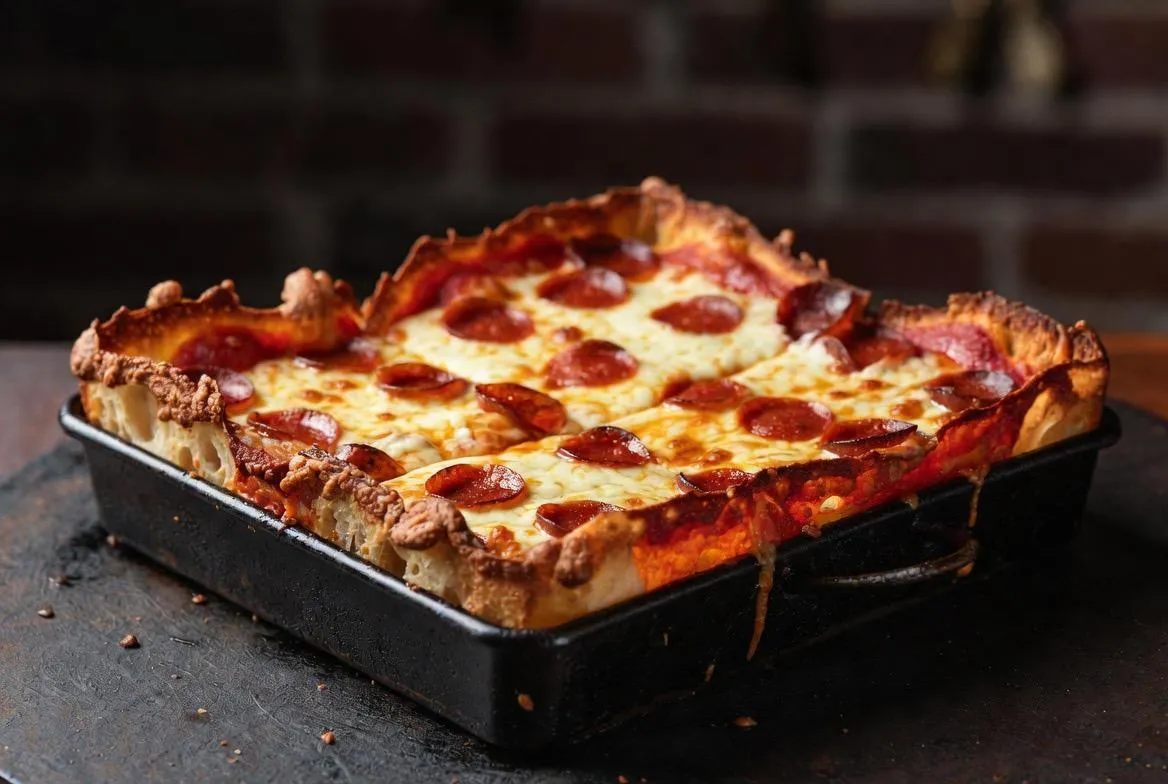
A Detroit pie is rectangular, baked in a high-sided steel pan. The dough is thick, airy, and focaccia-like—closer to Sicilian sfincione than to a New York fold. Wisconsin brick cheese (or a mozzarella–brick blend) is pushed all the way to the walls. Fat from the cheese fries against the hot steel and forms a dark, crispy frico edge—the caramelized corners people fight over. Pepperoni often goes under the cheese so it cups and renders into the crumb. Sauce is ladled on last in stripes or dollops, which is why locals call it a red top. Traditional pans are about 8×10 (four squares) or 10×14 (eight). 
1936–1946: a bar that needed food
Buddy’s Rendezvous opened in 1936 at Six Mile and Conant on Detroit’s east side, near Hamtramck. Gus Guerra and family had run it as a “blind pig” during Prohibition, then as a legal neighborhood bar. By 1946 the bar needed a menu. There was already a round-pizza shop in town (Vesuvio’s). Guerra wanted a thick Sicilian square. 
Two origin stories sit side by side and both get told in Detroit:
• Anna Guerra’s Sicilian mother (Grandma Passalacqua) taught a sfincione dough.
• Longtime employee Connie Piccinato, also Sicilian, is credited with teaching or refining the recipe.
Nobody has a signed recipe card from 1946. The product is not in dispute: Buddy’s baked the first version that became the city’s style.
The pan is the city
Baking pans of the right size were scarce. What Detroit had in surplus were blue-steel industrial trays—Dover Parkersburg pans from the 1930s–40s used in auto plants as drip trays and parts bins. Heavy, high-sided, they hold heat like cast iron. Dough oiled in that steel crisps on the bottom and sides; cheese that hits the wall burns into a lacy crust. Some original pans were still in service 50–75 years later. Shops do not wash the seasoning off. That container is why the pizza looks and tastes the way it does. Without the factories, you get Sicilian. With them, you get Detroit. 
1953: the family splits, the style multiplies
In 1953 Gus sold Buddy’s to partners Jimmy Valenti and Jimmy Bonacorsi and opened Cloverleaf Bar in East Detroit (now Eastpointe). The Guerra family still runs Cloverleaf. Buddy’s kept the same pizza and later passed to the Jacobs family, then expanded across metro Detroit. 
The next generation came out of those kitchens:
• Louis Tourtois, a Buddy’s pizza cook (the 1970 Detroit News newsroom contest winner was his pie), later cooked at Shield’s, then opened Loui’s Pizza in Hazel Park in 1978. Local papers called the late-’70s fight over who made the best square the “Detroit Pizza War.”
• Shield’s and other east-side rooms kept the same pan method.
• In 1970 The Detroit News ran a city-limits pizza tasting. Buddy’s won. Owners painted a blue ribbon on the Conant Street building. Cloverleaf, outside the city line, was left out and objected. The contest is one reason Buddy’s became the public face of the style. 
For most of the 20th century Detroiters just called it Buddy’s pizza, Sicilian, or square pizza. Wesley Pikula of Buddy’s has said he did not hear “Detroit-style” until a trade magazine used it in the 1980s. As late as 2007 some local coverage still said “Sicilian-style.”
Jet’s takes it beyond the city
In 1978 Eugene Jetts, on his way to buy a house in Sterling Heights, leased a party store instead and opened Jetts Party Shoppe and Pizzeria with his brother John. They used the same scrap-steel square pan. Jet’s later claimed a role in pushing the caramelized-corner idea hard and trademarked an “eight-corner” pie. The name became Jet’s Pizza in 1985; franchising followed. That chain is what first put a Detroit square in front of people who had never been to Conant Street. 
Little Caesars (Garden City, 1959) is a Detroit-area giant but built on round pies; it added Detroit-style nationally in 2013, after the style already had a name.
The national boom
Until the 2010s the pizza barely traveled. Then Michigan transplants and food media did what the factories had done for the pan: they exported the method.
• Via 313 in Austin, opened by Detroit brothers, is often cited as an early shop that used the words “Detroit-style” on purpose outside Michigan.
• Emmy Squared, Lions & Tigers & Squares, and others treated the frico edge as the selling point.
• Pizza Hut and other nationals added “Detroit” pies in the late 2010s.
The style is now common nationwide. Purists still argue that if the cheese does not fry up the walls of a heavy rectangular pan, and the sauce is not on top, it is just a thick square.
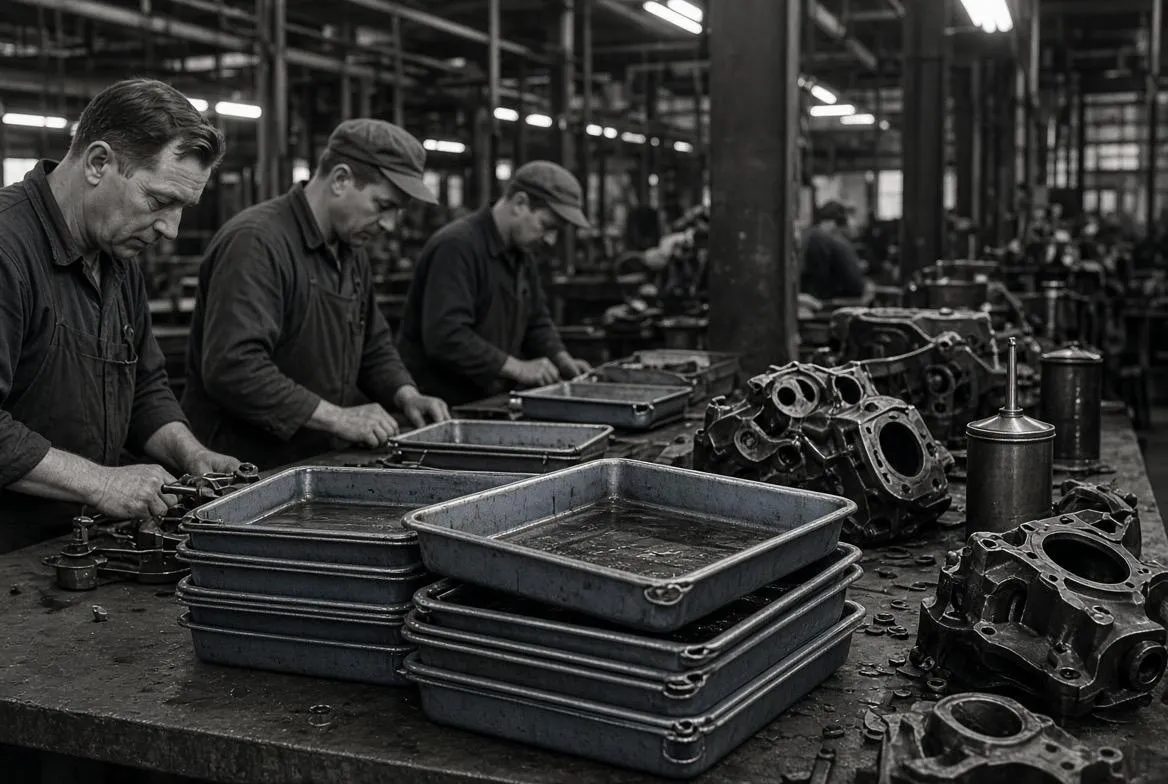
1930s. Blue-steel industrial trays made by companies such as Dover Parkersburg are common in Detroit auto plants. They hold parts, catch drips, and sit on factory benches. They are not kitchen equipment yet.
1936. Gus Guerra and family open Buddy’s Rendezvous at Six Mile and Conant on Detroit’s east side, near Hamtramck. It had been a Prohibition-era blind pig; now it is a legal neighborhood bar.
1946. The bar needs food. Guerra wants a thick Sicilian square, in the sfincione tradition. The dough recipe is credited either to Anna Guerra’s Sicilian mother or to employee Connie Piccinato—both stories are still told. Commercial square baking pans are scarce, so they stretch dough into leftover auto-plant steel trays. Pepperoni goes into the dough, Wisconsin brick cheese goes to the walls, sauce goes on last. That bake is the first Detroit square pizza.
Late 1940s. Returning World War II servicemen who had eaten Sicilian pizza in Italy help the square catch on. At Buddy’s it starts beating sandwiches as the thing people order.
1953. The Buddy’s partnership splits. Guerra sells the Conant Street shop to Jimmy Valenti and Jimmy Bonacorsi and opens Cloverleaf Bar in East Detroit (now Eastpointe), taking the same pizza with him. Buddy’s keeps making the square. Two houses now carry the style.
1950s–1960s. The square stays a Detroit and inner-suburb food. Locals call it Buddy’s pizza, Sicilian, or square pizza—not “Detroit-style.” Shield’s and other east-side rooms pick up the pan method.
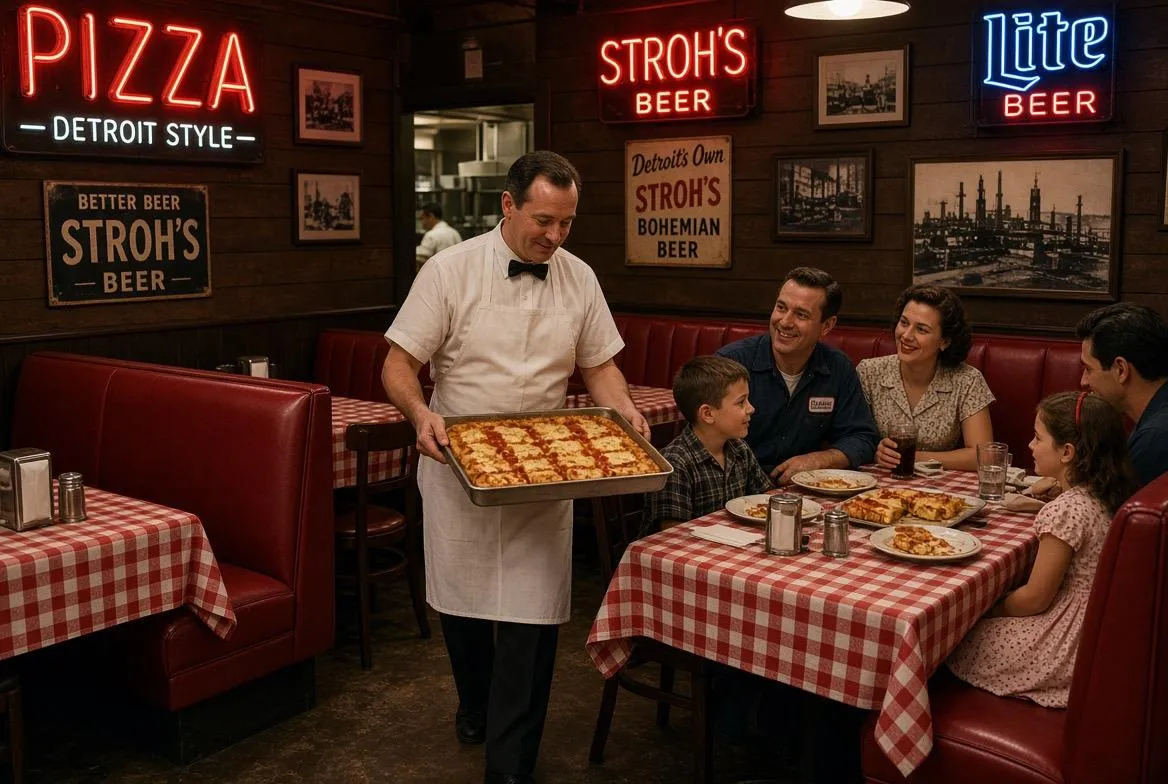
1970. The Detroit News holds a pizza tasting limited to shops inside Detroit city limits. Buddy’s, with pizza cook Louis Tourtois at the oven, wins. Owners paint a blue ribbon on the Conant Street building. Cloverleaf, outside the city line, is left out and objects. The contest is what first gives Buddy’s public bragging rights as the square.
1972 area. The Jacobs family later buys Buddy’s and keeps the original method while the chain grows around metro Detroit.
1978. Two expansions in one year. Eugene and John Jetts open Jetts Party Shoppe and Pizzeria in Sterling Heights instead of buying a house; they use the same scrap-steel square pan. Louis Tourtois, after Buddy’s and Shield’s, opens Loui’s Pizza in Hazel Park. Local papers treat the fight over who makes the best square as the “Detroit Pizza War.”
1985. Jetts Party Shoppe becomes Jet’s Pizza. Conveyor ovens and more stores follow. Jet’s later pushes caramelized corners and an eight-corner pie as its signature.
1980s. A trade magazine starts using the phrase “Detroit-style.” Even Buddy’s staff say they rarely heard that name before then. Most Detroiters still just say square pizza.
1990s–2000s. Jet’s franchises. Buddy’s and Cloverleaf stay regional institutions. As late as 2007 some local coverage still calls the pie Sicilian-style. Outside Michigan almost nobody knows it.
2010s. Michigan transplants and food media export the name on purpose. Via 313 in Austin is an early shop that labels the pizza Detroit-style. Emmy Squared and others sell the frico corner as the point. The style finally leaves the Midwest.
2013. Little Caesars, a Detroit-area chain built on round pies, adds Detroit-style nationwide—after the style already has a name.
Late 2010s–2020s. Nationals copy the rectangle. Purists keep the test simple: heavy steel pan, cheese fried up the walls, sauce on top. If those three are missing, it is only a thick square, not the 1946 Detroit pie.
Borrowing is viewed as a loss of freedom.
LEARN ABOUT OTHER FAMOUS PLACES: Old Town San Diego, Old Towne Orange, Old Town San Clemente, Old Town Monrovia, Old Town Tamecula, Old Town Pasadena, Old Town Sacramento, Old Town Bern, Old Town Stockholm, Old Town Prague, Old Town Lijiang, Old Town Alexandria, Old Town Albuquerque, Old Town Cottonwood, Old Town Quedlinburg, Old Town Rothenburg ob der Tauber, Old Town Marienplatz Munich, Flipside Point, Alexanderplatz Old Town Berlin, Old Town Chicago, Old Town Kissimmee Florida, Phuket Old Town, Old Town Asakusa, Old Town Madrid Major Square, Kraków Old Town, Old Town London Piccadilly Circus,
~ ADVENTURER QUOTE:
“Courage is being scared to death and saddling up anyway!” – John Wayne
Visit Us At:
FLIPSIDE POINT
~ “I don’t know, I’m making this up as I go.” — Indiana Jones ~
19171 Magnolia, Huntington Beach, CA 92646
"Thanks For Being Incredible!"
Great ARTICLES: How The Great Pyramid in Egypt Worked, History of RIIP Brewery, All About GREEK Mediterannean Food, World Cup Information, Best Restaurants of Huntington Beach, History of Huntington Beach Pier, Huntington Dog Beach, Old World Huntington Beach, History of Detroit vs. New York Pizza, History of Riip Pizza, History of the New York Pizza, History of the Detroit Deep Dish,
This website is owned and operated by (c) 2026 - University of San Clemente Inc.