
All about the New York Pizza!
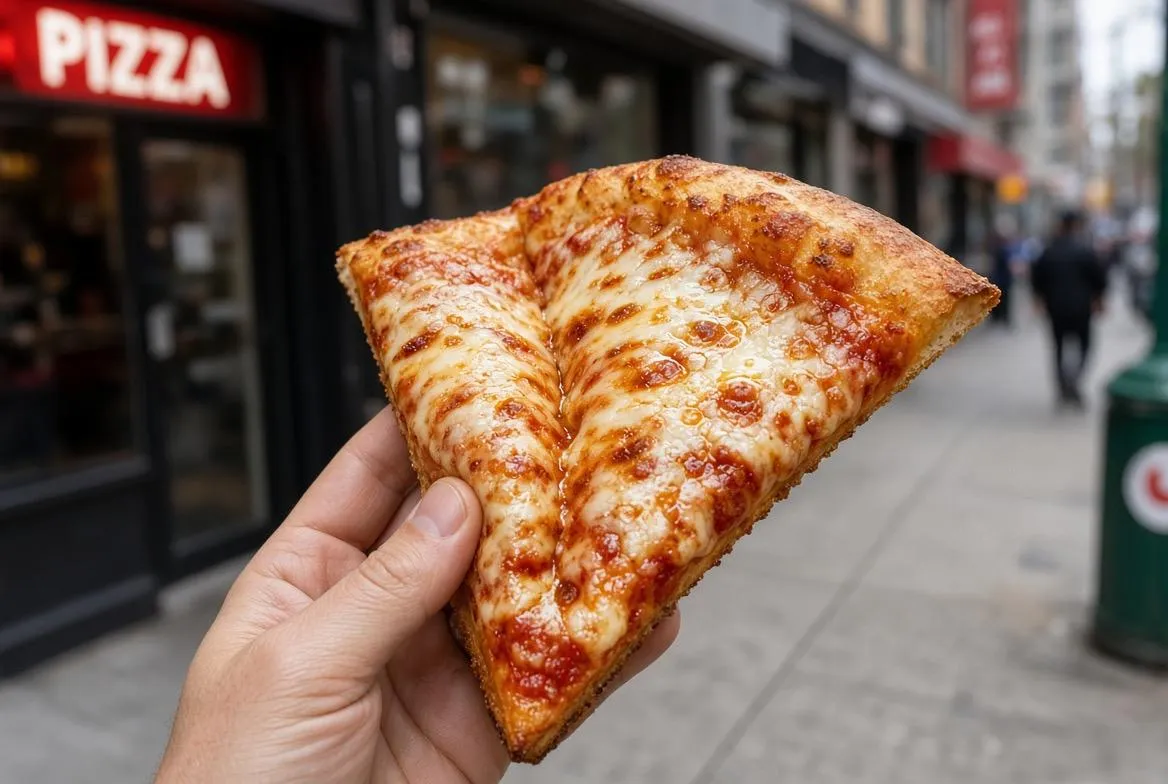
New York pizza is Neapolitan pizza rewritten by American flour, coal bread ovens, and a city that walks. It did not appear fully formed in 1905, and the famous “first pizzeria” story is only half true. What is true is the style: a large, thin, foldable pie that became the city’s default lunch.
What New York pizza actually is
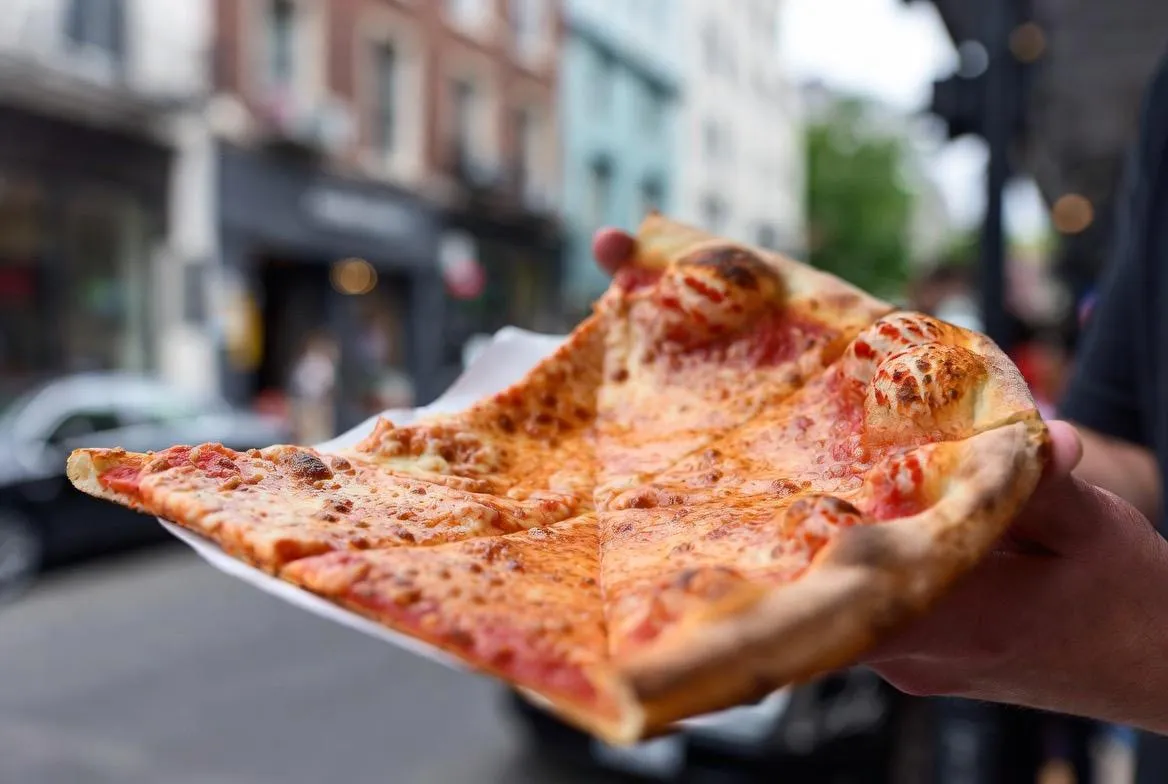
A classic New York pie is hand-tossed, usually 18 to 24 inches, cut into eight wide triangles. The crust is thin and pliable in the center so you can fold it, crisp only at the rim (the cornicione, sometimes called “the bone”). Traditional topping is a light uncooked tomato sauce and low-moisture shredded mozzarella—not a wet Neapolitan puddle. High-gluten American bread flour is what makes the chew and the fold. New York tap water is part of the lore; minerals in the city’s supply get credit for dough texture, though flour and oven matter more. 
There are two historical tracks that people now mash together under one name:
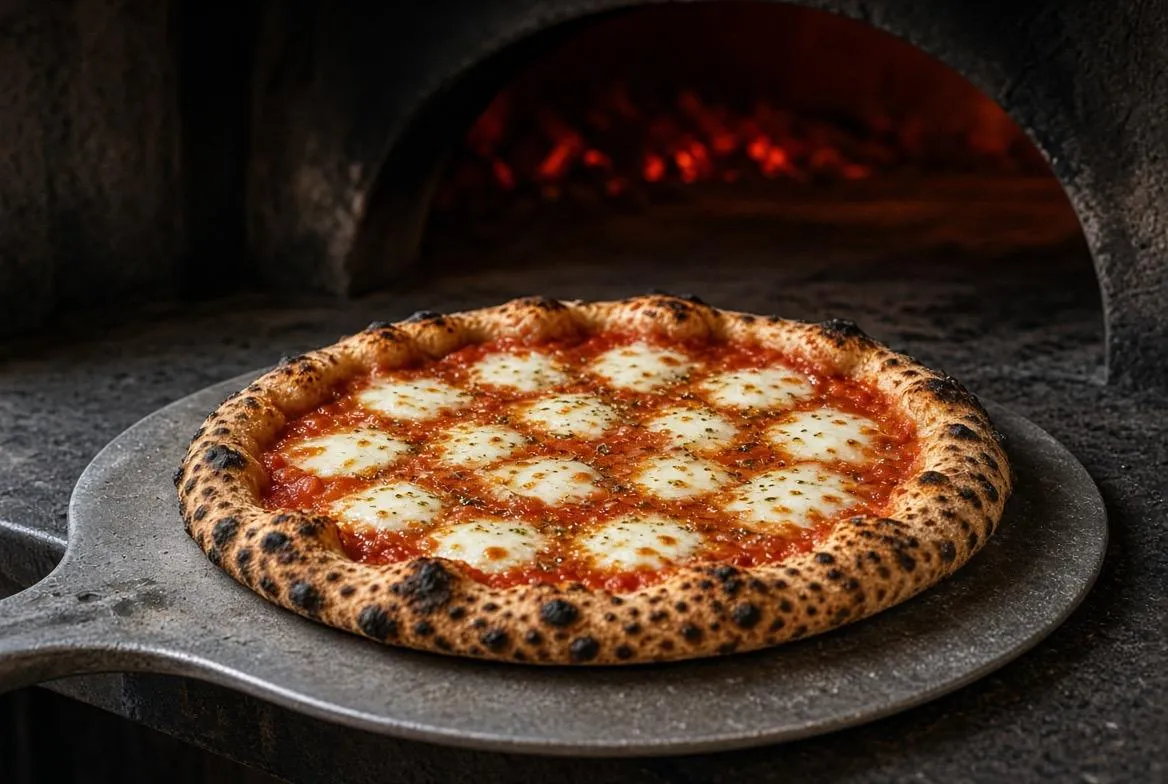
• Coal-oven whole pies — 800–1,000°F, leopard char, smoky, drier crust, sold whole and eaten hot.
• Gas-deck slice-shop pizza — 500–700°F, longer bake, oilier, foldable, reheated by the slice.
The first is the ancestor. The second is what most of the world means by “New York pizza.”
Naples to Mulberry Street
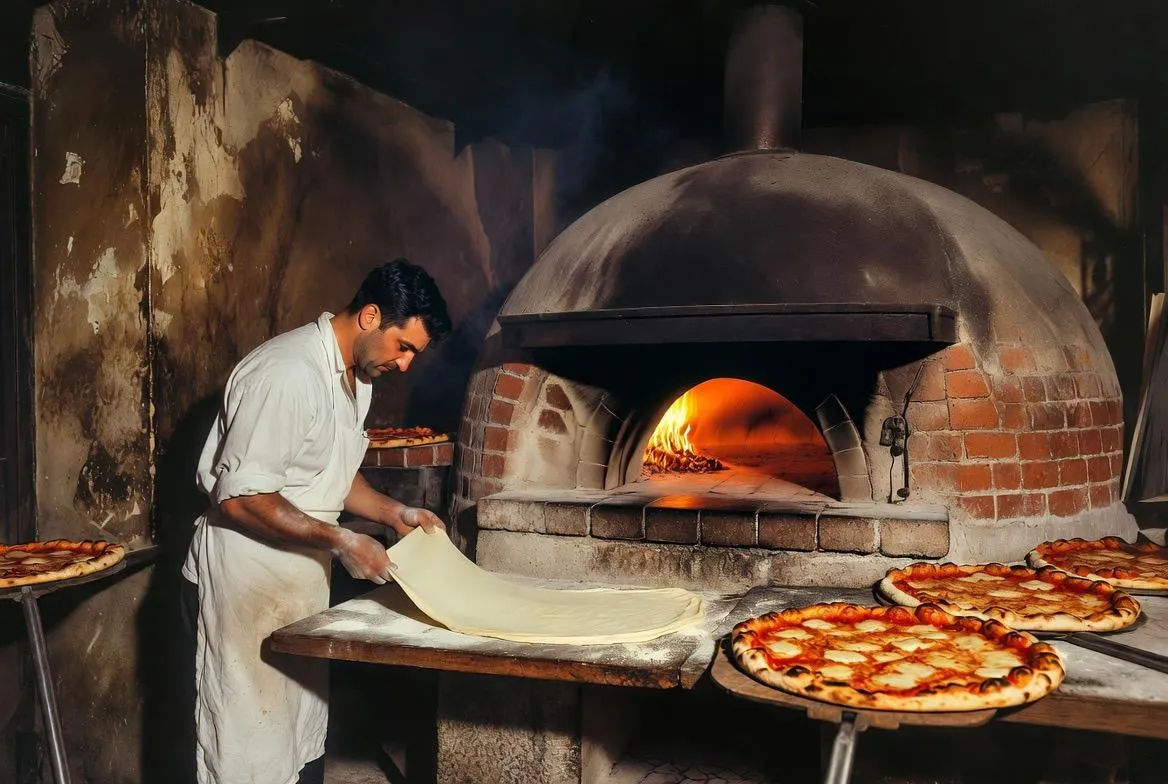
Southern Italian immigrants—especially from the Naples area—brought pizza to New York in the late 1800s and early 1900s. By 1920 about a quarter of the 1.6 million Italian immigrants in the United States lived in New York. They did not have Neapolitan wood ovens. They rented time in bakery coal ovens built for bread. Hard coal burned hotter and more efficiently in cramped city bakeries than wood. The longer, slightly cooler bake plus American wheat changed the pie: chewier dough, wider diameter, cow’s-milk mozzarella instead of buffalo. 
Early pies were often sold whole, wrapped in paper and tied with string, to factory workers who could not always buy an entire pizza. Paying for a cut piece is older than New York—street vendors in Naples already sold pizza by the slice—but New York made that the city’s rhythm.
The Lombardi myth, and what the records show
The plaque version: Gennaro Lombardi opened a grocery at 53½ Spring Street in Little Italy around 1897, got the first U.S. pizzeria license in 1905, and Antonio “Totonno” Pero baked the pies.
Primary-source work by historian Peter Regas (and later Scott Wiener and the Modernist Pizza team) complicates almost every part of that:
• Gennaro Lombardi was born in 1887 and arrived at Ellis Island in November 1904, age 17, listed as a laborer. He could not have founded an 1897 grocery.
• A pizzeria already existed at that Spring Street address. Filippo Milone, a Neapolitan pizzaiolo who opened and sold several shops, likely established it around 1898. Giovanni Santillo was advertising it as Antica Pizzeria Napoletana in March 1905—months after Lombardi landed.
• City directories list Giovanni Albano’s pizzeria at 59½ Mulberry Street by 1894, earlier than the Lombardi date.
• Lombardi did later own and run the Spring Street shop (briefly in 1908, then after 1918). The name “Lombardi’s Restaurant” dates to 1939. The original closed in 1984 and reopened a block away in 1994, so it is not America’s longest continuously operating pizzeria (Papa’s Tomato Pies in Trenton, 1912, holds that). 
Milone is the forgotten planter: he appears to have opened shops that later became famous as Lombardi’s, John’s, and Brooklyn’s Pop’s, then died in 1924 in an unmarked Queens grave. The Lombardi name still matters because that shop trained or launched the next generation.
The four prewar pillars
From those early coal shops came the houses that defined old New York pizza:
• Totonno’s, Coney Island, 1924. Antonio Pero left Spring Street after the subway reached Coney Island and opened his own coal-oven shop. Same family ran it for a century in the same building, same oven, same recipe. Fire in 2009, flood from Hurricane Sandy in 2012; in 2024 the family looked for a buyer. Whole pies only. 
• John’s of Bleecker Street. Documents put a shop there in 1915 under Milone (as Pizzeria Port’Alba). Giovanni “John” Sasso, related by marriage, took over around 1925. When he lost the Sullivan Street lease he dismantled the coal oven and rebuilt it at 278 Bleecker. Still whole pies, no slices, carved wooden booths. Sold to the Vesce family in the 1950s; still family-run. 
• Patsy’s, East Harlem, 1933, Patsy Lancieri. Coal oven; one of the earliest places credited with neighborhood slices.
• Lombardi’s remains the public monument even after the founding story was revised.
Those four—Lombardi’s, Totonno’s, John’s, Patsy’s—are the acknowledged prewar line.
The invention that created the slice joint
Coal ovens are slow to heat, hard to staff, and bake a pie that does not reheat well. Frank Mastro, an immigrant who ran a restaurant-supply business on the Bowery, wanted pizza to be as common as the hot dog. In the mid-1930s he converted a coal oven to gas, then had Blodgett manufacture a gas deck oven that held temperature while the door slammed open all day. Bakers Pride gas decks out of the Bronx followed in the 1940s. 
That oven is the real birth of New York slice culture. Lower heat (roughly 550–700°F), even bake, slices that can sit and be recrisped. You no longer needed a mason-built coal vault or a trained Neapolitan baker. Tiny storefronts could open. Patsy’s claims early slices; Nunzio’s on Staten Island sold them by 1943; Louie & Ernie’s by 1947; J&V in Bensonhurst around 1950 with delivery. After World War II, veterans who had eaten pizza in Italy and a city built for walking made the slice a default meal. By the late 1950s–1960s the slice joint was everywhere: Ray’s on Prince Street (1959), then the confusing army of “Original Ray’s.” Joe’s Pizza on Carmine Street (1975) became the textbook floppy, oily, foldable slice. 
Growth after the war
Pizza left Italian neighborhoods. It became a New York food, not an immigrant specialty—eaten in Bay Ridge and Bedford-Stuyvesant alike. Chains and suburbs copied the large thin pie. New York style spread nationally as “regular pizza,” distinct from Chicago deep-dish and later from certified Neapolitan.
Later chapters:
• 1984–1994: original Lombardi’s closes and returns nearby.
• 2001 onward: the dollar slice (99 Cent Fresh Pizza, then 2 Bros after 2008) turns the slice into recession street food.
• 2010s: a “slice renaissance”—places treating the gas-oven slice as seriously as the coal pie.
• Coal ovens are mostly grandfathered; new ones are tightly restricted, which is why the old rooms still matter.
Borrowing is viewed as a loss of freedom.
LEARN ABOUT OTHER FAMOUS PLACES: Old Town San Diego, Old Towne Orange, Old Town San Clemente, Old Town Monrovia, Old Town Tamecula, Old Town Pasadena, Old Town Sacramento, Old Town Bern, Old Town Stockholm, Old Town Prague, Old Town Lijiang, Old Town Alexandria, Old Town Albuquerque, Old Town Cottonwood, Old Town Quedlinburg, Old Town Rothenburg ob der Tauber, Old Town Marienplatz Munich, Flipside Point, Alexanderplatz Old Town Berlin, Old Town Chicago, Old Town Kissimmee Florida, Phuket Old Town, Old Town Asakusa, Old Town Madrid Major Square, Kraków Old Town, Old Town London Piccadilly Circus,
~ ADVENTURER QUOTE:
“Courage is being scared to death and saddling up anyway!” – John Wayne
Visit Us At:
FLIPSIDE POINT
~ “I don’t know, I’m making this up as I go.” — Indiana Jones ~
19171 Magnolia, Huntington Beach, CA 92646
"Thanks For Being Incredible!"
Great ARTICLES: How The Great Pyramid in Egypt Worked, History of RIIP Brewery, All About GREEK Mediterannean Food, World Cup Information, Best Restaurants of Huntington Beach, History of Huntington Beach Pier, Huntington Dog Beach, Old World Huntington Beach, History of Detroit vs. New York Pizza, History of Riip Pizza, History of the New York Pizza, History of the Detroit Deep Dish,
This website is owned and operated by (c) 2026 - University of San Clemente Inc.